On the morning of Aug. 10, 1825, the Marquis de Lafayette and President John Quincy Adams left the Belmont Manor House at about 10 a.m. to head back to Washington. They had been at a large celebration in Leesburg and stopped at Ludwell Lee's house on the way home. The heat that day was severe. Travis Shaw of the Virginia Piedmont Heritage Area told Ashburn Magazine that "one of their horses actually dropped dead on the road, leaving the carriage stranded for several hours."
That house is the clubhouse at Belmont Country Club today. 2026 is the club's 25th year, and the club has been running a year of anniversary events. Twenty-five years is a short stretch in the life of this building. Since Lee finished it in 1802, the house has had about a dozen owners, and each one used it for something different. Several of those owners left marks you can still find, most of them within a short drive of the first tee.
A house that changed hands every generation
The Virginia Department of Historic Resources holds the 1980 National Register nomination for Belmont. It dates the Federal-style house to 1799 through 1802 and lists its owners in order. The club later added its own chapters. Put together, the line runs like this:
- Ludwell Lee, 1799 to 1836. He built the house and lived there until he died on March 23, 1836.
- Margaret Mercer. She ran a school in the house.
- George Kephart, 1851. He bought it from Mercer's heirs. The club's history says he also owned the nearby Coton plantation.
- Frederick M. Staunton, 1887.
- John Scott Ferguson, 1907. Ferguson was from Pittsburgh, and he had the house modernized.
- Edward and Evelyn Walsh McLean, 1915. Evelyn Walsh McLean is best known as an owner of the Hope Diamond. Under the McLeans, Belmont was known as a fine horse farm.
- Patrick J. Hurley, 1932. Hurley had been Secretary of War under Herbert Hoover.
- George C. Clarke, 1943. He was a Washington, D.C., attorney who bought the estate and its contents from the Hurleys.
- IBM, 1969. The Clarkes kept a life interest in the house until the widowed Mrs. Clarke moved out in 1974.
- Toll Brothers, 1995. Toll bought the land and the manor house to build a gated community and golf course.
- ClubCorp, 2019. ClubCorp announced on Nov. 1, 2019 that it had bought Belmont and six other Toll Golf clubs. The company renamed itself Invited in 2022, and Invited still runs the club.
Some of these sales came out of hard times. The McLeans' horses were sold at auction in 1931 during the Depression, and the whole estate went to the Hurleys the next year. The sale after Mercer's death also matters for understanding the place. At a May 2025 ceremony, as Loudoun Now reported, historian Jay Harrison said Mercer had tried to use the plantation to show that farming could work without enslaved labor. He added that "ironically, after her death her executors sold the property to Alexandria's largest slave trader."
The rooms members use date mostly from 1907
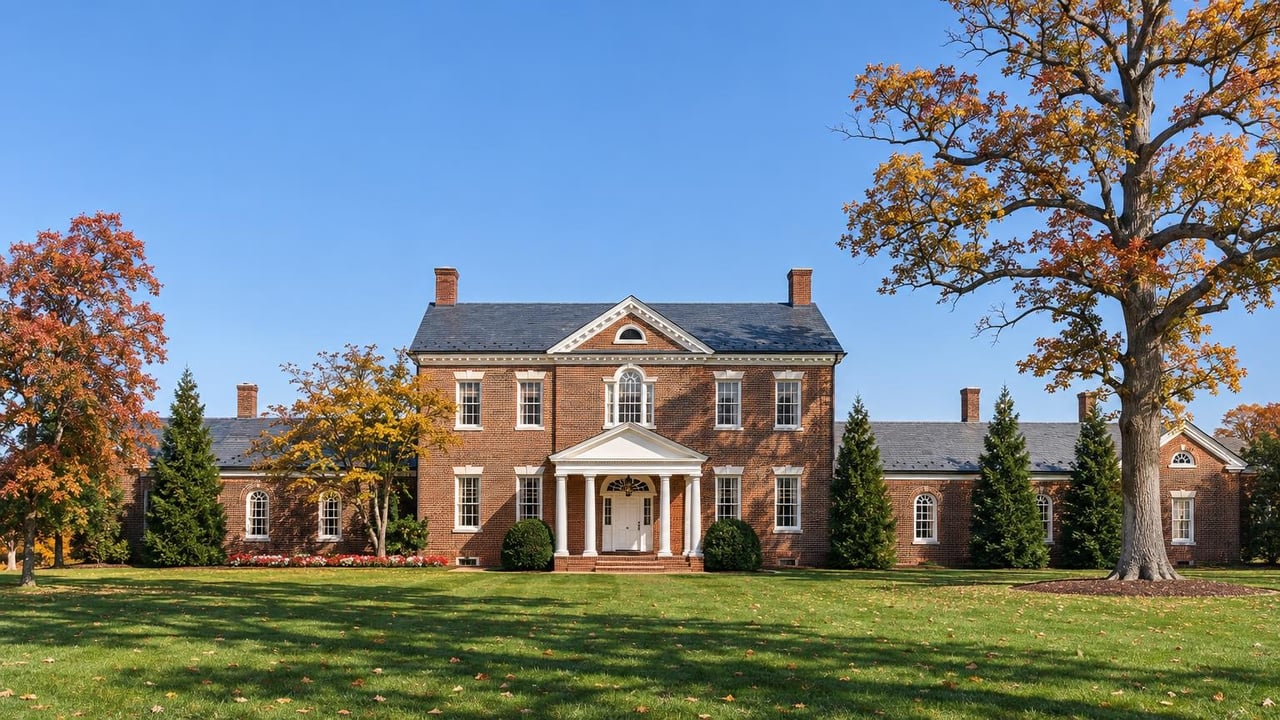
You might expect the Belmont you see today to be Ludwell Lee's 1802 house. In large part it is Ferguson's 1907 version. The nomination describes a five-part Federal mansion with a central block, hyphens and end wings. Ferguson's 1907 remodeling changed the hyphens and wings and replaced and enlarged the rear wing. The club credits architect T. Kent Roberts with that work. The 1980 nominators said the work held up well, writing that "the house has required little major work since." Upstairs, the main bedrooms kept their Federal woodwork, while "the rest of the second-floor rooms date from the 1907 restoration."
The club calls its dining space Lee's 1799 dining room. The nomination tells a different story about the room's age. It dates the dining room behind the stair hall to the 1907 remodeling, so the name honors Lee more than it records when the room was built.
How 1,100 acres became a 70-acre parcel, then a golf course
When Lee built the house, the property covered about 1,100 acres just east of Leesburg. That land was part of a 7,520-acre grant the Lee family got from Lord Fairfax in 1728. Lee was the first member of his family to actually live on it. By the time of the 1980 nomination, the house sat on a seventy-acre tract. The nomination calls it "the last surviving intact parcel" of the land Lee inherited through his first wife.
The same document describes the setting in 1980, when IBM owned the land. The house stood near the edge of a ridge looking east over the Potomac Valley. A tree-lined drive curved up to it from the old Leesburg Turnpike, which is Route 7 today. There were broad, level fields behind the house and modern farm buildings to the west. The fairways took the place of those fields after Toll's 1995 purchase. The club opened on Sept. 10, 2001, the day before the September 11 attacks. The club's own history says Arnold Palmer visited on Sept. 9, shortly before the opening.
Four places the older Belmont still shows
The best reason to know this history is that you can still find the traces, most of them on or near roads you already drive.
Ludwell Lee's grave. The nomination describes a walled cemetery near the farm buildings that holds Lee's grave. Loudoun Now's 2025 coverage confirms that Lee is buried on the property.
The first marker on the manor. On May 4, 2025, the Cameron Parish Chapter of the Daughters of the American Revolution held a ceremony to dedicate a historic marker on the manor house. Before then, no marker on the building explained its history.
The old gates on Route 7. If you drive east on Route 7 from Belmont Ridge Road, look to the right just before the Claiborne Parkway exit. You'll see the estate's old entrance. Ashburn Magazine reported in 2024 that the low stone walls and pillars are still in good shape. The metal hardware is still there, but the gate leaves are gone, and a crumbling drive runs up from them toward the manor. The Thomas Balch Library in Leesburg has a 1949 Winslow Williams photo of the gates when they were still in use. That drive is likely the one the 1980 nomination describes curving up from the turnpike.
The African-American Burial Ground for the Enslaved at Belmont. This site is at the southeast corner of Route 7 and Belmont Ridge Road. Many of the people buried there were enslaved at the Belmont and Coton plantations, the land that is now Belmont Country Club and Lansdowne on the Potomac. Loudoun Now reported that Toll Brothers' Belmont Land LP split the 2.75-acre corner off from its larger development. The company then gave it to the Loudoun Freedom Foundation, led by Pastor Michelle C. Thomas, which plans to preserve it as a historic site. Field stones placed more than a century ago mark the graves. Preservation Virginia has put the site on its list of Most Endangered Historic Places, and the same coverage calls it the largest known slave cemetery in Loudoun County. Thomas told the paper, "It will forever be our land and our history."
The mantel story and the landmark label
Two common stories about the house go further than the official record. The club's timeline says Lafayette gave the house its ornate mantels during his visit. The National Register nomination calls the Lafayette gift a tradition and says the mantels match the style of the house's own building period. That points to them being original to the house.
Trade coverage of the club has also called the manor a "National Historical Landmark." The state's register record lists two designations. The house was added to the Virginia Landmarks Register on Sept. 21, 1976, and to the National Register of Historic Places on Feb. 8, 1980, under reference number 80004198. Those listings are a different status from National Historic Landmark.
The Lafayette visit itself is well documented. Loudoun Now reports that Lafayette met his former aide-de-camp again at Belmont on Aug. 10, 1825, when Lee held a ball for his old commander. The same report says President James Madison spent two weeks at Belmont after British troops burned the President's House in Washington.
Where 25 years falls among Belmont's owners
The club's 25 years fall in the middle of the house's tenures. Lee held Belmont from 1799 until his death in 1836, more than three decades. The Clarkes owned it or lived in it from 1943 to 1974, which was 31 years. Both of those stays were longer than the club's. The McLeans owned it for seventeen years, and Hurley for eleven. Invited has run the club for seven of its 25 years, counting from ClubCorp's 2019 purchase.
For more on the community around the clubhouse, see our Belmont Country Club neighborhood page. If you like this kind of local history, our post on the history near River Creek's 13th hole covers similar ground a few miles up the Potomac.
A Belmont home sits in a community built around an 1802 house on the National Register, and that history is part of the home's setting. At the Matt Elliott Home Selling Team, we tell the neighborhood's story when we present a home to buyers. If you're thinking about selling in Belmont Country Club, request a free seller consultation and we'll talk through how to present your home and its setting to buyers.